Showing posts with label pronunciation. Show all posts

Wednesday, June 14, 2017

Is it Mamillary or Mammillary?

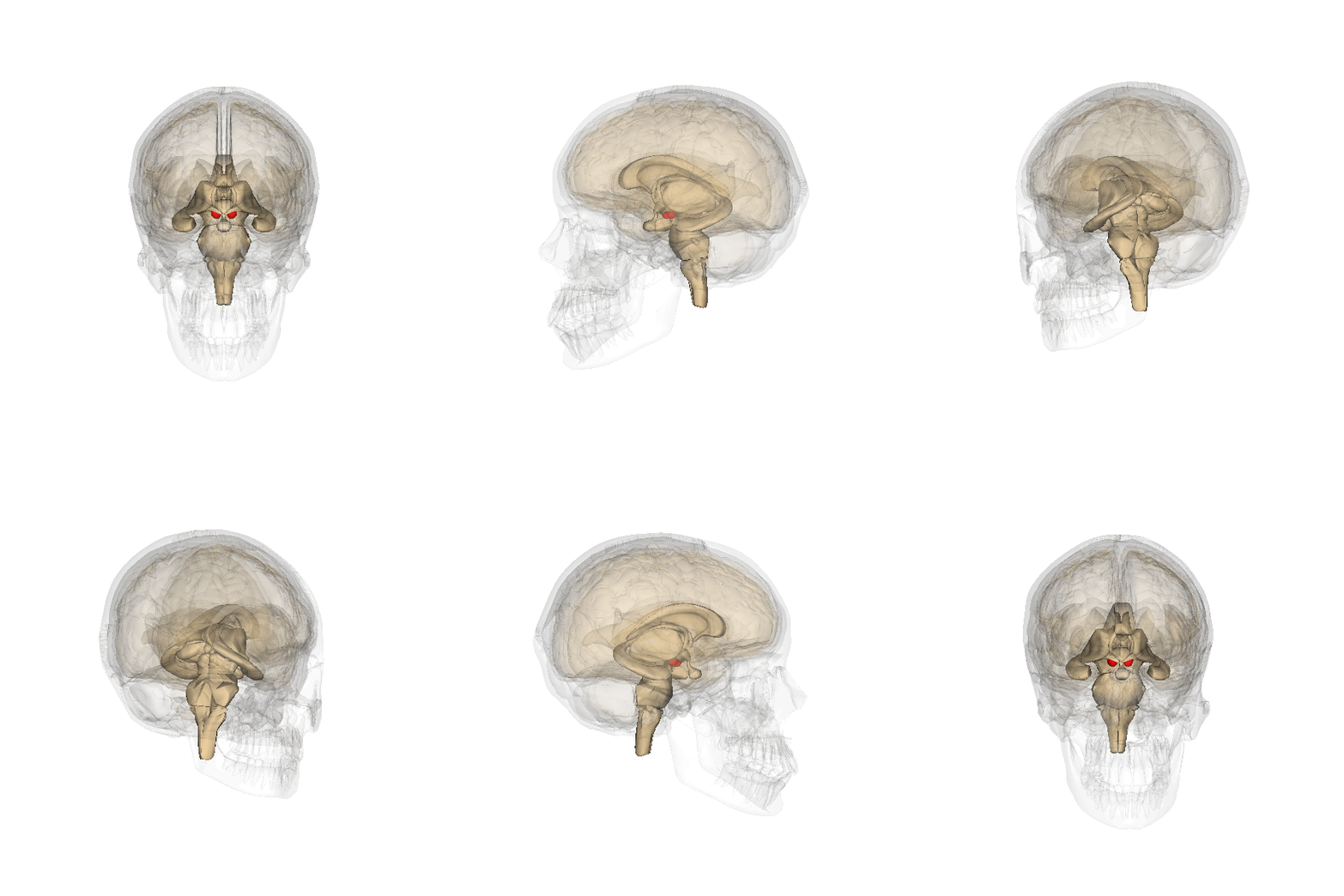
There are two acceptable spellings of this term that can be used to name a pair of hypothalamic nuclei in the brain (see the illustration below) and other structures that resemble a small human female breast:
mamillary
mammillary
MAM-mih-layr-ee
mam(m)- breast, -ill(a)- little,-ary relating to

Originally, it was mamillary from the Latin spelling of the term mamillaris. The variant mammillary arose because of the close association with the related English term mammary (relating to the breast).

Both spellings are widely used. In my textbook Anatomy & Physiology, I chose the former spelling (the "single m"). Mamillary is used in ICD-9 medical coding and in many medical textbooks) because it more closely follows the Latin word from which it is derived, mamillaris. As many of my readers have noticed, the parsing of Latin roots is a theme in our textbook that is not found in most other anatomy and physiology textbooks, so it makes sense that we'd go in this direction, given a choice of two acceptable spellings.


This brings up the interesting and important phenomenon that applies to both spelling and pronunciation: there are sometimes several acceptable alternates but we often assume that the way we learned it (or the way it appears in the teaching resources we use) is the only correct option.

Check out Mamillary or Mammillary? What's in an “m”?

It turns out that our learning of scientific and medical terminology is never complete and so we should always double-check misspellings (and mispronunciations) in case they turn out to be correct (even if odd) alternates with which we are not yet familiar.

You may also be interested in a previous post on variations in pronunciation of anatomical terms:

Graphic from Anatomography

Thursday, April 2, 2015

Say It Out Loud 18 Times

Want to learn your terminology quickly and easily?  In a recent post, I told you that one way to do that is to work on six new words every day.  My friend Jane, the foreign language professor, gave me another tip to help learn new terminology: say each new term out loud at least 18 times.

Apparently, there's evidence suggesting that to "own" a new word, you have to say it out loud at least 18 times.  The vocalization, along with the repetition, apparently help to reinforce memories in the various language areas in your brain.  Which means that you can recall and use the terms easily.

I know that seems silly . . . even childish.  But think about it.  Silly as it may seem, isn't it worth reducing your study time and improving your knowledge quickly?

Adapted from a post at The A&P Student

Tuesday, November 25, 2014

How Do You Pronounce It?


One of the trickiest parts of using professional terminology is getting the pronunciation down. There are at least two reasons pronunciation is important:
  1. You want to be understood, right?  Using a recognizable pronunciation make it more likely that professional communications will be accurate.  And in clinical settings, accuracy can be a matter of life and death.

  2. You have to pronounce it in your head!  Even if  we do not speak a term out loud, we sort of pronounce it "in our heads" as we read or write a term.  We really need some kind of pronunciation of a term for it to become part of our brain's operating "word list."
Okay, but how does one figure out how to pronounce a term correctly?

This is the usual pattern for developing your pronunciation of a term:
  1. Learn it from someone else.  You might pick up a pronunciation from a peer, a mentor, or a learning resource—or from the media.

  2. Look it up in a dictionary. Written and audio pronunciation guides are available in the major medical dictionaries, comprehensive dictionaries, and similar resources—some of which are freely available on the web.

  3. Use common pronunciation patterns.  Each language has it's own "typical" pronunciation guidelines, some of which may not be written down.  For medical terminology, one often uses either Latin pronunciation patterns or the pattern of your native language.
But here's where it gets tricky.  For some terms, there is no "correct" pronunciation—only several possible alternate pronunciations. That's the nature of human language.  It is variable and dynamic in usage, meaning, spelling, and pronunciation.  

Dictionaries are an attempt at standardization of language, but cannot be absolutely comprehensive. Even if there was one universally accepted dictionary, it would change over time as our languages change. 

Besides the futility of an unchanging standard for pronunciation, there are regional differences related to dialect. I speak a form of midland-urban U.S. English and my wife speaks a form of southern-rural U.S English.  Which of us is "correct" in our variations of pronunciation?  Hmmm.  I suggest that it's best to call us both correct.  As long as we can understand each other accurately.

Even in Latin and Greek there are dialect differences that affect pronunciation.  I once had a colleague declare a pronunciation to be the "correct Latin pronunciation" of a term.  But that puzzles me because the earliest memory I have from my first Latin course was an explanation of the different systems of pronouncing Latin—and which one we were to use in our course.  I don't think the system we used is very common in medical circles, because I find my pronunciations of Latin terms a bit out of the mainstream on occasion.  Maybe that's what prompted my colleague to declare his version of "correct Latin pronunciation." 

I think we should make continuous, strong efforts to use "mainstream" pronunciations when using professional terminology.  For the sake of accuracy and safety in our communications, such effort is essential.  

But for many terms, we need to understand that pronunciations may legitimately differ—perhaps from regional variations or perhaps from whom one learned their Latin.  And I think we need to train our ears and our tongues to adapt to different pronunciations when we encounter them.  

I think SKEL-uh-tal muscle tissue is okay here in Missouri, but I think I'll be better understood in Calgary or Liverpool if I talk about skeh-LEE-tul muscle tissue.  

And, FYI, if you hear me say FOR-uh-men, I'm really talking about a fuh-RAY-men.  Blame my Latin teacher, if you must lay blame somewhere.
Wednesday, November 12, 2014

Bone Names Have Meaning


Using the language of the human skeleton can be intimidating for a number of reasons.  Not the least of which is that the names of the bones and bone features seem to be very odd—sometimes almost unpronounceable.

There's a reason the names are so odd.  They're based on a foreign language!  They're all based on Latin, with a lot of Greek word parts mixed in there. Once you realize that you're using a new language as you master the details of the human skeleton, it will hopefully be a  bit less intimidating.

It turns out that if you actually focus on the fact that these are terms from a foreign language and try to translate them, then using the terminology of skeletal anatomy is far easier—and takes far less time and effort to learn—than if you ignore the meanings of bone names.

To help you get started on this road, I've produced a couple of very brief videos that outline a proven method to quickly and easily learn the bones and bone features of the human skeleton.  Watch them both to get the greatest benefit.

In the videos, I mention a couple of lists of translations (and pronunciations) that will help you engage the method I'm recommending.  Links to those lists are found below.


Want to know more?


List of bone marking types
  • Translation of each term
  • Pronunciation of each term
  • Brief description of each term
  • my-ap.us/16PNh3K

List of bones and bone markings of the human skeleton
  • Translation of each term
  • Pronunciation of each term
  • Use with your textbook or Survival Guide for Anatomy & Physiology (below), which has a description of each structure
  • my-ap.us/15zZYom

Field Guide to the Human Body:  Bone Names

Survival Guide for Anatomy & Physiology
  • Many time-saving, effort-saving, and frustration-saving tips and shortcuts
  • my-ap.us/16aa5zg
Photo credit: sklmsta