Showing posts with label advanced. Show all posts

Wednesday, June 14, 2017

Is it Mamillary or Mammillary?

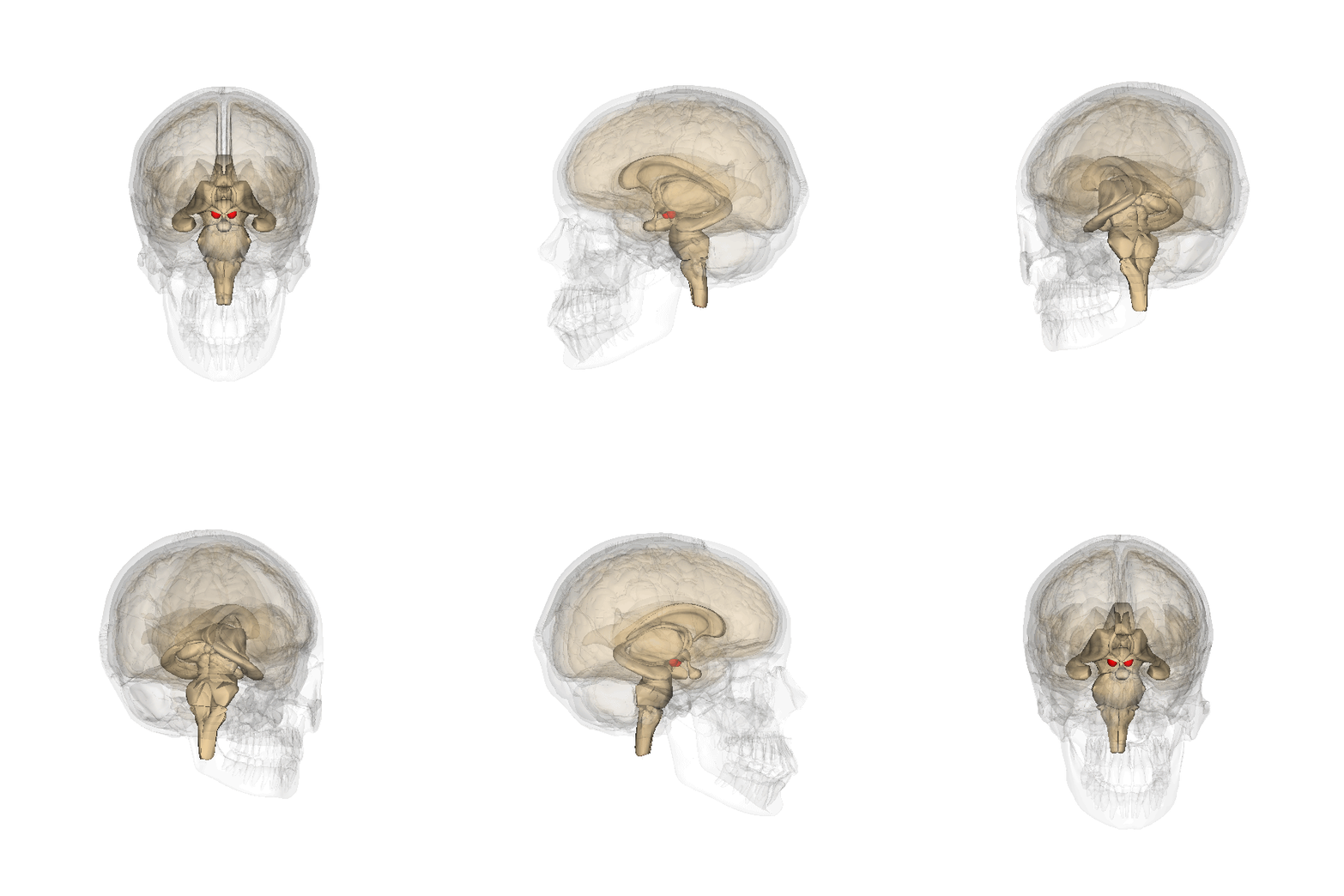
There are two acceptable spellings of this term that can be used to name a pair of hypothalamic nuclei in the brain (see the illustration below) and other structures that resemble a small human female breast:
mamillary
mammillary
MAM-mih-layr-ee
mam(m)- breast, -ill(a)- little,-ary relating to

Originally, it was mamillary from the Latin spelling of the term mamillaris. The variant mammillary arose because of the close association with the related English term mammary (relating to the breast).

Both spellings are widely used. In my textbook Anatomy & Physiology, I chose the former spelling (the "single m"). Mamillary is used in ICD-9 medical coding and in many medical textbooks) because it more closely follows the Latin word from which it is derived, mamillaris. As many of my readers have noticed, the parsing of Latin roots is a theme in our textbook that is not found in most other anatomy and physiology textbooks, so it makes sense that we'd go in this direction, given a choice of two acceptable spellings.


This brings up the interesting and important phenomenon that applies to both spelling and pronunciation: there are sometimes several acceptable alternates but we often assume that the way we learned it (or the way it appears in the teaching resources we use) is the only correct option.

Check out Mamillary or Mammillary? What's in an “m”?

It turns out that our learning of scientific and medical terminology is never complete and so we should always double-check misspellings (and mispronunciations) in case they turn out to be correct (even if odd) alternates with which we are not yet familiar.

You may also be interested in a previous post on variations in pronunciation of anatomical terms:

Graphic from Anatomography

Wednesday, April 15, 2015

Modern Use of Eponyms

I love eponyms!

I'm a bit sad that eponyms—terms that include a proper name—are going out of style in the world of human sciences, it seems.

Paul Langerhans
The international lists of anatomic terminology recommend against most eponyms, providing descriptive terms in their place.  For example, pancreatic islet is the term  preferred to the eponym islet of Langerhans.  Osteon is preferred over haversian system.

Of course, I get that.  Descriptive terms are more intuitive and therefore easier to understand, learn, and remember. Related to that is that they are more accurate when it comes to medical applications.  And I'm all about accuracy in the medical professions.

It's just kind of fun using eponyms.  And kind of sad to feel like I am leaving behind all those wonderful women and men who discovered our parts way back when.

But it's not just the international lists of anatomy that are leaving eponyms behind—all the "authorities," including most medical textbooks are doing it. Professional societies, associations, and boards in the basic sciences and the health professions are doing it.  So if we want to be "in style" with our terminology—and more importantly, make sure our students are sporting the latest linguistic style—we'd better pay attention to the trends, eh?

Let me give you some unasked-for fashion tips if you want to be stylish in your use of professional terminology:

Avoid eponyms

If there's an accepted descriptive term, it's best to use that rather than the eponym.

Be bilingual

Some folks you'll encounter are old-fashioned or possibly don't know the newer descriptive term.  Or they know both and use them interchangeably.  Because we're on the cusp of a fashion revolution here, the most competent professionals will know both and be able to switch back and forth easily as the context requires. The goal is to understand and be understood, right?

What to do if you have to use an eponym

Then use an eponym! There are some commonly used terms for which there really isn't a great descriptive term to replace an eponym.  For example, Parkinson disease, Alzheimer disease, and other disorders often don't have a widely accepted alternative. So absolute avoidance of eponyms is not (yet) possible.

Fashionable uses of eponyms

If you must use an eponym, the trendy folks at AMA and elsewhere avoid the use of possessive forms.  For example, notice how I used the term Parkinson disease above and not Parkinson's disease?  It's better to use Down syndrome than Down's syndrome—and even better to use trisomy 21 syndrome.

Likewise, the possessive loop of Henle is out of favor but using Henle loop may still get you into most of the trendy clubs.

Illusory eponym styles

When you try to get away with using a possessive form of an eponym and yet still avoid arrest by the fashion police, you have to be very cunning.  Here's a common way that's done: use the adjective form of a proper name.  So if you want to honor Gabriele Falloppio's work in describing uterine tubes, then use his Latinized name (Fallopius) in the form of an adjective and call them Fallopian tubes.

Gabriele Falloppio
But, you may say, that's not a very clever masking of the fact that it's an eponym. In fact, it's pretty obvious, right?  Well here's the sly part: cover it up by using a lowercase letter—thus obscuring the fact that it incorporates a proper noun. That's why many sources use fallopian tube instead of Fallopian tube.

Terms like eustachian tube and haversian canal may not seem like well-hidden eponyms in our context here, where we're actually focusing on eponyms. But most grand stage illusions—like Blackstone's making an elephant appear on stage from thin air—rely on such subtle misdirection.

So when you are using an adjective form of an eponym, it's best not to capitalize it and risk possible arrest by the fashion police.

Fashion rules are not really rules

With any fashion, the "rules" are not usually rules in the formal sense.  They are simple formulations of trends that, if heeded, will likely save you some embarrassment when you don't appear to be cool.  So if you have a good reason—or even a lame reason—to ignore these rules, I think you'll probably survive. People laugh (even hoot) at my disregard for current clothing fashion all the time—you get used to it.

OK, sometimes fashion rules really are rules

As with any professional communication, sometimes fashion rules get set in stone in a required style to which you must adhere in your work.  Sort of like a dress code for words. For example, students learn how to use professional styles when we require that they submit their assignments in APA, Chicago, or CBE style. Likewise, in publishing journal articles, books, and other works, there are rules established that provide consistency—and, therefore, also accuracy.  Each publisher, sometimes each journal or textbook, has it's own house style that defines such things. So if your journal editor insists on Eustachian tube instead of auditory tube or eustachian tube, then I recommend doing it.  Retro, in some contexts, can be cool.

Adapted from The A&P Professor

Thursday, February 19, 2015

The Pleasure of Learning New Words

Recent research shows that learning new words triggers the reward circuits of our brain—making it a pleasure to learn and study terminology.  Like you didn't already know that!

In a study published in the journal Current Biology, researchers have experimentally proved that human adult word learning exhibits activation not only of language regions of the cerebral cortex, but also of the ventral striatum (VS)—a core region of reward processing.

Results confirm that the motivation to learn new words is preserved throughout the lifespan, helping infants learn their first language and adults to acquire a second language.

Want to know more?


The Role of Reward in Word Learning and Its Implications for Language Acquisition
  • P Ripollés, et al. Current Biology. 3 November 2014. Vol 24. Issue 21. DOI: http://dx.doi.org/10.1016/j.cub.2014.09.044
  • Original research article.
  • my-ap.us/1Dzod24


Learning a new word stimulates the same region of the brain as sex
  • F. MacDonald  Science Alert. 29 OCT 2014
  • Plain English summary of the research.
  • my-ap.us/1ALmipP


Photo: adapted from Landesbibliotek
Some content adapted from a press release.

Wednesday, October 15, 2014

Gray anatomy or grey anatomy?


When you are looking at nervous tissue, do you discuss GRAY matter or do you discuss GREY matter? or does it really matter?

Yes, it does matter. It depends on whether you are communicating in a United States (U.S.) dialect of English or a United Kingdom (U.K.) dialect of English.

Ordinarily, in U.S. English, the color is spelled GRAY.  In U.K. English, the color is usually spelled GREY.

Actually, in U.K. English, one would state, "the colour is grey" because of the color/colour difference in spelling.

But does spelling matter?  I say YES.

My reasons are spelled out in detail in the article Does Spelling Matter? at The A&P Student. In that article, I discuss the fact that in the health professions, spelling errors are a grave matter of safety. Even small differences in spelling can have unintended, tragic consequences. And that means that during the training of health professionals, we should do all we can to learn how to communicate perfectly—and thereby learn to communicate safely.

I'll get back to the importance of spelling in a subsequent article.  For now, let's focus on the idea that U.S. and U.K. English have some differences in spelling, a few of which I summarize below.

Quick points about U.S. versus U.K. spelling differences


Professional communication requires correct spelling

  • Correct spelling avoids confusion and mistakes in communication
  • In the health professions, correct spelling is therefore a safety factor

Correct spelling in English varies from region to region

  • It is best to use the spelling correct to your particular regional context

Because communication is global, we frequently encounter regional variations

  • To avoid confusion, it best to be familiar with spellings used in other regions

U.K. English is not universal outside the U.S.

  • Canada, Australia, and some other regions use a mix of U.S. and U.K. spellings
  • Even in the U.K., some have adopted selected U.S. spellings

There are exceptions to every rule

  • Specific institutions and publications sometimes adopt spelling styles not typical of their regions
  • Some disciplines and specialties have adopted their own spelling styles, regardless of region
  • Some people have accidentally picked up spellings from outside their region and therefore use a mix of regional spelling styles
  • Some U.S. spellings are commonly (and correctly) used in the U.K. and some U.K. spellings are commonly (and correctly) used in the U.S.

Be resilient

  • Language is dynamic, producing regional dialects and spelling styles—so be on the lookout for changes as your regional language evolves


Some examples of U.S. versus U.K. spelling differences


The e/ae/oe vowels

Some words in U.S. English that use the e vowel instead use the ae or oe  diphthong in U.K. English.

U.S.
U.K.
fetus
foetus
esophagus
oesophagus
feces
faeces
hemoglobin
haemoglobin
estrogen
oestrogen
cecum
caecum
anesthesia
anaesthesia


The -er/-or endings

Some words in U.S. English that end in -er instead end in -re in U.K. English.

U.S.
U.K.
meter
metre
centimeter
centimetre
liter
litre
milliliter
millilitre
center
centre
fiber
fibre

The -or/-our endings

Some words in U.S. English that end in -or instead end in -our in U.K. English.

U.S.
U.K.
flavor
flavour
color
colour
labor
labour
behavior
behaviour
humor
humour

The -ize/-ise endings

Some words in U.S. English that end in -ize instead end in -ise in U.K. English.

U.S.
U.K.
organize
organise
visualize
visualise
organize
organise
characterize
characterise
metastasize
metastasise

The -yze/-yse endings

Some words in U.S. English that end in -yze instead end in -yse in U.K. English.

U.S.
U.K.
lyze
lyse
hydrolyze
hydrolyse
catalyze
catalyse
paralyze
paralyse

The -og/-ogue endings

Some words in U.S. English that end in -og instead end in -ogue in U.K. English.

U.S.
U.K.
catalog
catalogue
homolog
homologue
analog
analogue


Miscellaneous spelling differences

Some words in U.S. English have any of a variety of spelling differences in U.K. English.

U.S.
U.K.
gray
grey
disk
disc
glycerin
glycerine
mold
mould
neuron
neurone
sulfur, sulfate
sulphur, sulphate
anesthesia
anaesthesia


There are many other spelling differences among various dialects of English, but these examples give you sense of the concept.


Gray's Anatomy


Primed by the title of this article, you may be wondering which of these is proper:

Gray's Anatomy
Grey's Anatomy

It depends.

If you are referring to the classic anatomical treatise originally penned by Henry Gray and illustrated by Henry Vandyke Carter, then you should use Gray's Anatomy.

If instead you are referring to a television series featuring the character Meredith Grey, then you should use Grey's Anatomy.  The creators of this show about medical professionals intentionally played on the popularity of the anatomy reference—but in doing so, probably confused a lot of people!